CAB-381-0.5 | Cellulose Acetate Butyrate for Coatings, Inks and Specialty Applications
CAB-381-0.5 is a grade of Cellulose Acetate Butyrate (CAB) developed for use in specialty industrial formulations. As a cellulose ester, CAB combines film-forming properties with useful surface characteristics, resin compatibility, and formulation flexibility.
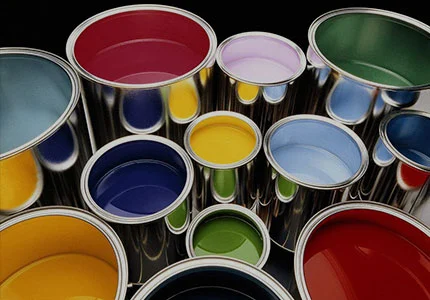
CAB-381-0.5 can be evaluated for applications including coatings, printing inks, lacquers, wood finishes, plastic coatings, automotive coatings, and other specialty polymer formulations.
With appropriate grade selection and formulation design, cellulose acetate butyrate can help manufacturers achieve a balance of film formation, surface appearance, hardness, flexibility, drying behavior, and compatibility.
What Is CAB-381-0.5?
CAB-381-0.5 is a cellulose acetate butyrate material based on chemically modified cellulose. Cellulose acetate butyrate contains both acetate and butyrate groups, giving it a combination of properties that differs from conventional cellulose and other cellulose derivatives.
The performance of CAB depends on factors such as ester composition, molecular characteristics, viscosity, solvent compatibility, and interaction with other formulation components.
CAB-381-0.5 is intended for formulators and manufacturers seeking a cellulose-based polymer for industrial and specialty applications.
Key Features of CAB-381-0.5
CAB-381-0.5 can offer useful characteristics for industrial formulation development, including:
Excellent film-forming characteristics
Good surface appearance
Useful resin compatibility
Balanced hardness and flexibility
Good formulation flexibility
Suitable solvent-system compatibility
Cellulose-derived polymer structure
Potential for improved coating performance
Suitable for specialty industrial formulations
The actual performance of CAB-381-0.5 depends on the complete formulation, processing conditions, resin system, solvent system, and intended application.
CAB-381-0.5 Specifications
Property | CAB-381-0.5 |
Product Name | Cellulose Acetate Butyrate |
Product Grade | CAB-381-0.5 |
Chemical Type | Cellulose Ester |
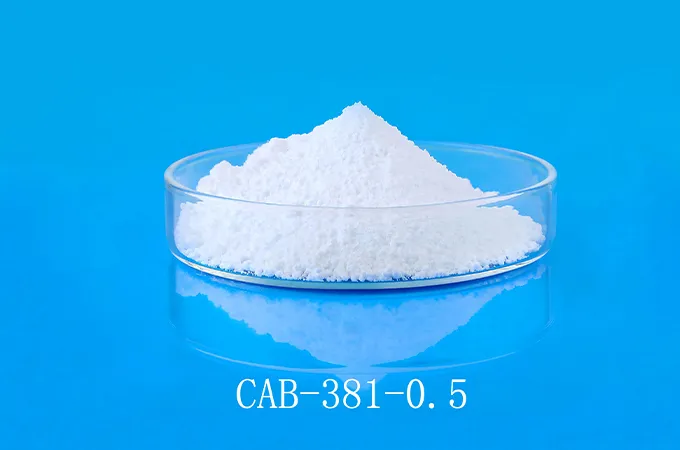
Appearance | White to off-white solid |
Acetyl Content | 3.5 wt % |
Butyryl Content | 38 wt % |
Viscosity | 0.5 |
Moisture | 3.0 max % |
Ash Content | <0.05% |
Solubility | Solvent-dependent |
Application | Coatings, inks, lacquers, plastics and specialty formulations |
Packaging | According to customer requirements |
Technical Note: The exact specification of CAB-381-0.5 should be confirmed using the latest manufacturer's TDS and COA. Product parameters may vary according to manufacturing specifications.
Applications of CAB-381-0.5
1. Industrial Coatings
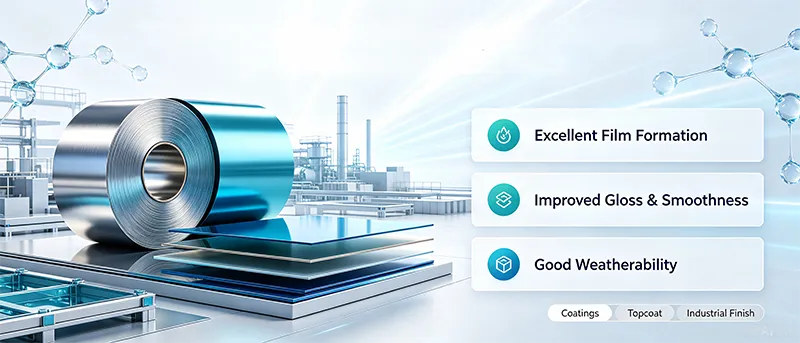
CAB-381-0.5 can be evaluated in industrial coating formulations where film formation, surface appearance, drying characteristics, and compatibility with other formulation components are important.
2. Automotive Coatings
Cellulose acetate butyrate is used in selected automotive and transportation coating systems. It can contribute to film formation, surface appearance, flexibility, hardness, and formulation performance.
3. Wood Coatings and Finishes
CAB can be considered for wood coating and finishing systems where smooth film formation, appearance, durability, and controlled drying characteristics are required.
4. Printing Inks
CAB-381-0.5 may be evaluated as a polymeric component in selected printing ink formulations. Its film-forming properties and compatibility with formulation components can support surface and processing performance.
5. Lacquers
CAB is suitable for consideration in lacquer formulations requiring controlled film formation, surface quality, flexibility, hardness, and drying behavior.
6. Plastic Coatings
CAB-381-0.5 can be evaluated in specialty plastic coating formulations where adhesion, surface appearance, hardness, flexibility, and compatibility are important.
7. Specialty Polymer Formulations
As a cellulose ester, CAB can be incorporated into specialty polymer formulations where cellulose-derived materials and specific film-forming characteristics are required.
Benefits of Cellulose Acetate Butyrate in Formulations
Cellulose acetate butyrate is valued for its combination of cellulose-derived chemistry and polymeric performance.
Depending on the grade and formulation, CAB can help support:
Performance Area | Potential Contribution |
Film Formation | Supports formation of a continuous polymer film |
Surface Appearance | Can contribute to smooth and attractive surfaces |
Hardness | Helps formulate coatings with controlled film hardness |
Flexibility | Can provide a useful balance between hardness and flexibility |
Drying | Can influence coating and lacquer drying characteristics |
Compatibility | Can work with selected resin and solvent systems |
Processing | Provides formulation flexibility for specialty applications |
Final performance should always be confirmed through formulation testing.
CAB-381-0.5 for Coating Formulations
Coatings manufacturers can evaluate CAB-381-0.5 when developing systems that require a combination of film-forming ability and controlled surface properties.
CAB can interact with resins, solvents, pigments, plasticizers, and other additives. Therefore, the selection of the CAB grade should be based on the complete formulation rather than on viscosity alone.
Laboratory evaluation can help determine the appropriate addition level and compatibility with the selected coating system.
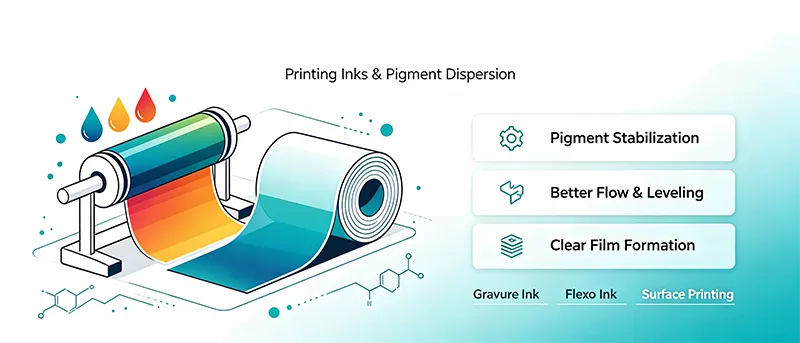
CAB-381-0.5 for Printing Inks
Cellulose acetate butyrate can be used in selected printing ink formulations as a functional polymer component.
Depending on the ink system, CAB may contribute to:
The recommended grade and dosage should be determined through testing with the actual pigment, resin, solvent, and additive system.
How to Choose the Right CAB Grade?
Selecting a CAB grade requires consideration of both raw-material characteristics and final product requirements.
Selection Factor | Importance |
Viscosity | Influences formulation rheology and processing |
Acetyl Content | Affects chemical and formulation characteristics |
Butyryl Content | Influences flexibility, solubility and compatibility |
Molecular Characteristics | Can affect film properties and rheology |
Solvent Compatibility | Important for dissolution and formulation stability |
Resin Compatibility | Helps maintain a stable formulation |
Application Method | Spray, printing and coating methods may require different properties |
Final Film Properties | Determines suitability for the finished application |
For new formulations, laboratory-scale compatibility testing is recommended before commercial production.
CAB-381-0.5 Quality Control
Consistent raw-material quality is important for manufacturers using CAB in commercial formulations.
Typical quality-control parameters may include:
A Certificate of Analysis (COA) can be used to verify that each production batch meets the agreed specification.
Packaging and Storage
CAB-381-0.5 should be stored in accordance with the supplier's technical and safety documentation.
Recommended general storage practices include:
Store in a cool and dry location.
Keep packaging tightly sealed.
Protect from moisture and contamination.
Maintain suitable ventilation.
Avoid inappropriate heat and ignition sources.
Follow the manufacturer's SDS for detailed handling requirements.
Packaging can be customized according to order quantity, transportation requirements, and customer needs.
CAB-381-0.5 Global Supply
For international buyers, reliable supply of CAB-381-0.5 requires consistent product quality, suitable packaging, technical documentation, and professional export support.
A qualified CAB supplier can provide:
Technical Data Sheet (TDS)
Safety Data Sheet (SDS)
Certificate of Analysis (COA)
Product specifications
Packaging options
Samples
Batch information
Export documentation
Technical application support
Customers should confirm the latest technical documentation before commercial purchasing.
CAB-381-0.5 FAQ
What is CAB-381-0.5?
CAB-381-0.5 is a grade of cellulose acetate butyrate, a cellulose ester used in coatings, inks, lacquers, plastics, and specialty industrial formulations.
What is cellulose acetate butyrate used for?
Cellulose acetate butyrate is used in selected coating, lacquer, printing ink, wood finishing, automotive, plastic coating, and specialty polymer applications.
What are the main properties of CAB?
CAB can provide useful film-forming, surface, hardness, flexibility, drying, and compatibility characteristics depending on the grade and formulation.
Is CAB-381-0.5 suitable for coatings?
CAB grades can be evaluated for various coating systems. Final suitability depends on the resin, solvent, pigments, additives, application method, and required film properties.
Can CAB-381-0.5 be used in printing inks?
CAB can be considered for selected printing ink systems. Compatibility testing with the specific resin, pigment, solvent, and additive system is recommended.
How should CAB-381-0.5 be stored?
The product should generally be kept sealed in a cool, dry, and well-ventilated environment. Always follow the supplier's current SDS and storage instructions.
How can I select the correct CAB grade?
Consider viscosity, ester composition, solvent compatibility, resin compatibility, processing conditions, application method, and final product requirements.
What documents are available for CAB-381-0.5?
Typical documents include a TDS, SDS, COA, specification sheet, packaging information, and relevant export documentation.
Request a Quote for CAB-381-0.5
Looking for CAB-381-0.5 Cellulose Acetate Butyrate for your coating, ink, lacquer, plastic coating, or specialty formulation?
Contact our sales team to request:
CAB-381-0.5 TDS
SDS
COA
Product samples
Bulk pricing
Packaging options
Lead time
Technical support
CAB-381-0.5 provides a cellulose-based polymer option for manufacturers developing high-performance industrial and specialty formulations.


 English
 日本語
日本語 français
 Deutsch
 Español
 العربية
 Türkçe
 italiano
 русский
 português
 Nederland

 MSDS Cellulose Acetate Butyrate CAB