Introduction
Cellulose Acetate Butyrate (CAB) is a cellulose ester widely used as a film-forming resin and performance additive in coatings, particularly automotive, industrial, plastic, wood, and specialty coating systems. Its combination of film formation, compatibility, flow control, surface properties, and weathering performance makes it useful when formulators need to improve both appearance and functional performance.
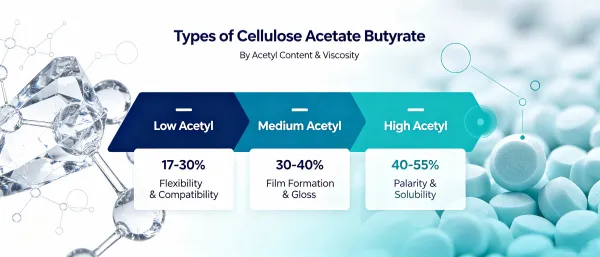
CAB is identified by CAS No. 9004-36-8 and is produced by chemically modifying cellulose with acetate and butyrate groups. Different CAB grades vary in butyryl content, hydroxyl content, molecular weight, viscosity, and solubility, so grade selection can significantly affect coating behavior.
Commercial CAB grades demonstrate benefits including improved flow, thermal reflow, intercoat adhesion, clear-film formation, reduced surface tack, and good UV stability.
But how exactly does CAB improve coating performance?
The answer involves several mechanisms: film formation, flow and leveling, pigment orientation, compatibility, drying behavior, surface appearance, adhesion, flexibility, and durability.
CAB Improves Film Formation
One of the most important functions of CAB is its ability to contribute to film formation.
When a coating is applied, the liquid formulation must transform into a continuous solid film as solvents evaporate or the coating cures. Poor film formation can lead to roughness, poor appearance, weak adhesion, or surface defects.
CAB can function as a film former and is capable of producing clear films when appropriately dissolved. Certain commercial grades are specifically described as cellulose esters with film-forming properties.
Film-Formation Benefits
CAB Contribution | Potential Coating Benefit |
Film formation | Continuous and uniform coating film |
Compatibility | Better integration with selected resin systems |
Flow improvement | Smoother surface |
Surface modification | Reduced defects |
Flexibility | Reduced brittleness in suitable systems |
Adhesion contribution | Better intercoat performance |
UV stability | Improved durability in suitable formulations |
CAB should therefore be regarded as more than a conventional thickener. It can directly influence the structure and properties of the final coating film.
CAB Improves Flow and Leveling
Flow and leveling are critical for achieving a smooth coating surface.
After application, coating materials need to distribute themselves evenly across the substrate. If the formulation does not level adequately, it can produce brush marks, orange peel, uneven film thickness, or other surface imperfections.
SpecialChem identifies CAB as a component that can contribute to improved leveling in solvent-borne industrial and automotive coating systems.
Commercial CAB-551 grades are also described as improving flow and thermal reflow.
Why Flow Matters
Poor Flow | Improved Flow |
Uneven surface | Smoother film |
Visible application marks | Better appearance |
Poor pigment distribution | More uniform appearance |
Surface irregularities | Improved leveling |
Increased defect risk | Better surface quality |
The actual effect depends on resin chemistry, solvent balance, pigment loading, application method, and CAB grade.
CAB Helps Control Automotive Pigment Orientation
CAB has an important role in automotive coatings, especially metallic and pearlescent finishes.
Metallic flakes need to orient appropriately within the coating film. Poor orientation can cause inconsistent appearance, color variation, or differences in brightness depending on viewing angle.
Eastman reports that cellulose esters such as CAB can enhance automotive basecoats by improving the orientation of metallic and pearlescent pigments, while helping color consistency and minimizing defects.
This makes CAB particularly relevant to automotive coating systems where visual appearance is a major performance criterion.
CAB in Automotive Basecoats
Coating Requirement | CAB Contribution |
Metallic pigment orientation | Better flake control |
Color consistency | More uniform appearance |
Surface quality | Reduced defects |
Film formation | Smooth coating development |
Solvent release | Can support faster solvent release in suitable systems |
Early hardness | Can contribute to earlier film hardness development |
These benefits are formulation-dependent and should be verified using the actual coating system.
CAB Can Improve Surface Appearance
A high-quality coating needs more than good adhesion and durability. Appearance is often equally important.
CAB can help reduce several types of surface imperfections. Commercial CAB-551-0.2 and CAB-551-0.01 grades are described as reducing surface tack and mottling and minimizing cratering, while improving flow and thermal reflow.
This can be particularly valuable in automotive refinishing and high-quality industrial coatings.
Surface-Quality Effects
Surface Issue | Potential CAB Effect |
Mottling | Can help reduce appearance variation |
Cratering | Can help minimize surface defects |
Poor leveling | Can improve flow |
Excessive tack | Can reduce surface tack |
Uneven metallic appearance | Can improve pigment orientation |
Rough film | Can contribute to smoother film formation |
CAB should not be viewed as a universal defect eliminator. Contamination, substrate preparation, solvent evaporation, application conditions, and resin compatibility can all contribute to coating defects.
CAB Improves Compatibility With Other Resins
Modern coatings often contain multiple resin components rather than a single binder.
A formulation may combine CAB with acrylic resins, polyurethane-related systems, crosslinking resins, or other film-forming components.
Some CAB grades are specifically described as compatible with numerous crosslinking resins.
CAB grade selection therefore provides formulators with an additional tool for controlling resin compatibility.
Factors Affecting Compatibility
Factor | Why It Matters |
Molecular weight | Influences solution viscosity and compatibility |
Butyryl content | Influences solubility and resin interaction |
Hydroxyl content | Can affect crosslinking potential |
Viscosity grade | Affects formulation viscosity |
Solvent system | Determines dissolution and stability |
Resin chemistry | Determines compatibility |
CAB dosage | Influences final film properties |
For example, Eastman's product catalog indicates that some higher-hydroxyl CAB grades provide greater crosslinking potential, while other grades emphasize low viscosity or compatibility.
CAB Influences Coating Drying and Solvent Release
Coating manufacturers often need to balance application viscosity, drying speed, film formation, and solvent release.
CAB can influence these characteristics because the cellulose ester participates in the formulation's resin and solvent environment.
Eastman reports that cellulose esters used in automotive basecoats can promote faster solvent release and early hardness development in suitable systems.
However, CAB should not simply be added to make every coating dry faster. Solvent selection, ambient temperature, film thickness, airflow, resin chemistry, and application conditions remain important.
CAB Can Improve Intercoat Adhesion
In multi-layer coating systems, the interaction between different coating layers is critical.
Examples include:
· Primer + basecoat
· Basecoat + clearcoat
· Plastic substrate + coating
· Automotive refinish systems
· Industrial multi-layer coatings
Certain CAB grades are reported to provide intercoat adhesion benefits.
Good intercoat adhesion can help reduce the risk of delamination and improve the integrity of a multilayer coating system.
Nevertheless, adhesion must always be tested on the actual substrate and with the complete coating system.
CAB Can Contribute to Flexibility and Toughness
CAB grade selection can also affect mechanical properties.
Some higher-butyrate CAB grades are described as producing flexible films, while other CAB/resin combinations can provide tough films with resistance to marring and weathering.
This gives formulators an opportunity to balance hardness and flexibility.
Mechanical Performance Considerations
CAB Characteristic | Potential Effect |
Higher butyrate content | Can increase flexibility in suitable systems |
Molecular weight | Influences film strength and solution behavior |
Hydroxyl content | Can influence crosslinking |
CAB/acrylic combination | Can produce tough films |
Plasticizer requirement | Depends on grade and formulation |
Film thickness | Influences final mechanical behavior |
The optimum balance depends strongly on the target coating.
CAB Supports Weather and UV Performance
Durability is particularly important for exterior automotive and industrial coatings.
Some commercial CAB grades are reported to provide good UV stability, while CAB combined with thermoplastic acrylic resins can produce films with weathering and mar resistance.
This does not mean CAB alone replaces dedicated UV absorbers or weathering additives. Instead, CAB can contribute to the overall durability package.
A complete outdoor coating formulation may still require:
· UV absorbers
· HALS
· Antioxidants
· Appropriate pigments
· Durable binder systems
· Proper crosslinking
How CAB Grade Selection Affects Coating Performance
Not every CAB grade provides the same performance.
For example, Eastman's catalog includes low-viscosity CAB grades designed for relatively high-solids formulations, higher-viscosity grades offering film strength and hardness, and grades with different butyryl and hydroxyl levels for different formulation requirements.
Example Grade-Selection Considerations
Requirement | CAB Selection Direction |
Low formulation viscosity | Consider lower-viscosity grade |
High-solids coating | Consider grade designed for lower application viscosity |
Hard film | Evaluate appropriate higher-viscosity/higher molecular-weight grades |
Flexible film | Consider suitable higher-butyrate grades |
Strong crosslinking | Evaluate hydroxyl content |
Pigment orientation | Evaluate automotive coating grades |
Solvent compatibility | Check CAB/solvent compatibility |
Fast formulation development | Use supplier technical data and laboratory samples |
These are selection principles rather than universal grade recommendations.
CAB in Different Coating Applications
CAB can be used across a range of coating applications.
Application | Potential CAB Function |
Automotive basecoats | Pigment orientation and appearance |
Automotive refinish | Flow, appearance, film formation |
Plastic coatings | Adhesion and film properties |
Industrial coatings | Flow and film performance |
Wood coatings | Film formation and surface appearance |
Protective coatings | Film properties and durability |
Clearcoats | Clarity and surface quality |
Specialty coatings | Compatibility and rheology modification |
Printing-related coatings | Film formation and flow |
Commercial CAB product portfolios include automotive OEM, automotive refinish, automotive plastics, protective coatings, plastic coatings, and other coating applications.
How to Optimize CAB in a Coating Formulation
Adding CAB without testing is unlikely to provide consistent results. A better approach is to optimize the complete formulation.
Step 1: Define the Target
Determine the required:
· Gloss
· Flow
· Leveling
· Hardness
· Flexibility
· Adhesion
· Weather resistance
· Drying speed
· Solvent resistance
Step 2: Select the CAB Grade
Compare molecular weight, viscosity, butyrate level, hydroxyl content, solubility, and compatibility.
Step 3: Check Solvent Compatibility
Confirm that the selected CAB dissolves adequately in the intended solvent blend.
Step 4: Conduct Dosage Screening
Evaluate multiple CAB concentrations rather than assuming that a higher dosage is better.
Step 5: Test the Complete Coating
Measure both appearance and physical performance.
CAB Coating Performance Testing
Test | Purpose |
Viscosity | Application behavior |
Flow and leveling | Surface quality |
Gloss | Appearance |
Haze | Film clarity |
Adhesion | Coating/substrate bonding |
Hardness | Mechanical resistance |
Flexibility | Resistance to cracking |
Impact resistance | Mechanical durability |
Solvent resistance | Chemical durability |
Weathering | Outdoor durability |
UV exposure | Light stability |
Recoat/intercoat adhesion | Multilayer compatibility |
Testing should be performed using the actual resin, pigment, solvent, substrate, and application method.
Frequently Asked Questions
1. What is the main function of CAB in coatings?
CAB can function as a film former and coating modifier, contributing to flow, leveling, surface appearance, compatibility, intercoat adhesion, and durability depending on the grade and formulation.
2. Does CAB improve coating gloss?
CAB can contribute to improved surface flow and leveling, which may support better appearance and gloss. However, final gloss also depends on resin, pigment, substrate, film thickness, surface roughness, and application conditions.
3. Does CAB improve coating leveling?
Yes. CAB is recognized as a component that can improve leveling in suitable solvent-borne industrial and automotive coating systems.
4. Can CAB improve automotive coatings?
Yes. CAB is widely used in automotive coating applications. It can help with metallic and pearlescent pigment orientation, flow, appearance, film formation, and selected durability properties.
5. Does CAB improve UV resistance?
Certain CAB grades are reported to provide good UV stability. However, overall UV durability depends on the entire coating formulation and should be verified through accelerated and/or outdoor testing.
6. Can CAB be combined with acrylic resin?
Yes. Certain CAB grades are compatible with acrylic and other resin systems. CAB/acrylic combinations are used to obtain particular combinations of film toughness, weather resistance, surface quality, and application properties.
7. How do I choose the right CAB grade?
Consider viscosity, molecular weight, butyryl content, hydroxyl content, solubility, resin compatibility, solvent system, desired film properties, and application method.
8. Does higher CAB viscosity always mean better coating performance?
No. Higher viscosity can contribute to certain film properties, but excessive formulation viscosity may negatively affect application, solids content, and flow. Grade selection should be based on the complete formulation.
9. Is CAB suitable for high-solids coatings?
Some low-viscosity CAB grades are specifically designed for applications requiring lower application viscosity at relatively high solids levels.
10. How should CAB performance be evaluated?
Evaluate the complete coating for viscosity, flow, leveling, gloss, adhesion, hardness, flexibility, solvent resistance, weathering, and other application-specific requirements.
Cellulose Acetate Butyrate improves coating performance by combining film-forming capability with flow control, leveling, compatibility, surface-quality improvement, adhesion, flexibility, and durability characteristics.
Its value is especially evident in automotive and industrial coating systems where appearance and processing performance must be carefully balanced. Commercial CAB grades demonstrate improvements in flow, thermal reflow, intercoat adhesion, UV stability, film clarity, and surface-defect control, while different grades offer different viscosity, molecular-weight, butyrate, hydroxyl, and solubility characteristics.
The most important point for formulators is that CAB is not a one-grade-fits-all additive. A low-viscosity grade may be useful for high-solids formulations, while another grade may be selected for hardness, flexibility, compatibility, pigment orientation, or crosslinking requirements.
For manufacturers developing high-performance coatings, the correct CAB selection should therefore begin with the desired coating properties and proceed through solvent compatibility testing, dosage optimization, resin compatibility evaluation, and complete coating-performance testing.
When properly selected and formulated, CAB can serve as an effective cellulose-based specialty resin for improving both the appearance and functional performance of modern coating systems.


 English
 日本語
日本語 français
 Deutsch
 Español
 العربية
 Türkçe
 italiano
 русский
 português
 Nederland